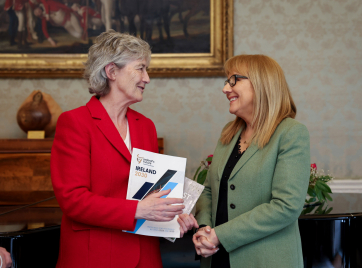
Speech by President Catherine Connolly - New Year’s Greetings to the Diplomatic Corps
Áras an Uachtaráin, 11:00 am, Wednesday, 21st January, 2026
A Oirirceasa,
A Aire,
Your Excellencies,
Minister,
It is my pleasure to welcome you to Áras an Uachtaráin. As we mark the beginning of 2026, let me convey my sincere best wishes to you, your spouses, partners and families and to the citizens of the countries you represent. I would like also to thank His Excellency Archbishop Montemayor who will speak on your behalf as Dean of the Diplomatic Corps. May I congratulate Minister McEntee on her appointment as the first woman to hold the position of Minister of Foreign Affairs. I would like to thank today’s harpist Lucy Brennan and the band members of Filidh for today’s wonderful music (Filidh to play after this speech?).
As today’s gathering is my first New Year’s greeting to you as President of Ireland, I would like to acknowledge the important work you do as diplomats, advocating on behalf of citizens and state, and building bridges across cultures. I hope that your time in Ireland will be filled with fond memories and proud achievements, both personally and professionally.
Now, more than ever, in this time of global uncertainty and tension, characterised by catastrophic conflict, humanitarian and climate crises, and ever-accelerating technological change, we look to you as our friends and partners to deepen our engagement, to collaborate and cooperate to meet the challenges of our time.
As it happens, the date of the election to choose the 10th President of Ireland, 24th October 2025, coincided with the 80th anniversary of the entry into force of the United Nations Charter, known as ‘UN Day’. The Charter, legally binding on all 193 UN Member States, has at its core a vision for a world in which the protection of peace, equality and human rights is paramount. We must not forget that the Charter was written in the aftermath of World War II and the Holocaust. It was drawn up by people with direct experience of the horrors of war, people who had a deep understanding of the fundamental importance of international law. The Charter remains the cornerstone of modern-day multilateralism.
Significantly, Ireland marked its 70th year of UN membership in 2025, and we remain steadfast supporters of the multilateral order despite the immense pressure it faces in today’s world. The United Nations, at its best, provides us with the architecture and the fora for the peaceful resolution, and prevention, of war.
The UN Charter is clear in its purpose and intent, expressing a determination to "save succeeding generations from the scourge of war" and, significantly, it reaffirms faith in fundamental human rights.
Its objectives include maintaining international peace and security, developing friendly relations based on self-determination, and achieving international cooperation in solving global problems. It stresses the sovereign equality of all members, the peaceful settlement of disputes, and the prohibition of the threat or use of force against any state.
Notwithstanding the Charter, there is more conflict now than at any time since World War II in places as disparate as Ukraine, the Middle-East and Sudan, as well as less-publicised conflicts in the Sahel, Myanmar and the Great Lakes regions of Africa. We witness the ongoing denial of rights in Afghanistan and the humanitarian crisis in Yemen, a consequence of the disregarding of international law and the UN Charter.
We witness an appalling humanitarian situation in Gaza where there is not enough food, adequate shelter, or sufficient healthcare access. Israel’s highly restrictive controls continue to obstruct an effective humanitarian response. We must end the suffering of Palestinian civilians in Gaza through the rapid, safe and unhindered delivery of principled humanitarian aid. We must chart a political path forward that can lead to two states, Israel and Palestine, living side by side in peace.
It is now almost four years since Russia’s illegal invasion of Ukraine. Ireland remains unequivocal in our support for, and in solidarity with, the people of Ukraine. Our vital humanitarian and stabilisation assistance will continue. We welcome ongoing efforts to achieve a just and lasting peace. We must also work together to urgently relieve the humanitarian crises in Yemen, Syria and Lebanon which continue to be fuelled by conflict.
All of which leads us to a most fundamental question: how have we departed from, even abandoned, this agreed language of peace and moved to a language in which war has become normalised and peace undermined, in which violence and force are seen as the solutions to the resolving of our differences?
In the space of eighty years, the international community moved from the clear, hard-won language of universal rights to something more evasive: a vocabulary of qualifications, exceptions, of 'special cases'.
Commitments that were meant to apply to all human beings have been recast as privileges granted to some, or withheld from others. We have learned to speak of suffering in qualifying language, to name atrocities in a passive voice, to replace obligations with 'concerns', and to treat the deliberate violation of law as a matter for competing narratives. And now the circle closes, with a new clarity, but a clarity stripped of conscience, morality and not based on international law.
The consequence of ‘might is right’ is now crystal clear before our eyes – countries can be invaded at will, or threatened with invasion and the UN organisations doing invaluable work in extremely dangerous locations can be demolished on a whim. When this becomes the logic of international relations, language no longer protects the vulnerable; it simply records their fate.
We must reflect, honestly and urgently, on how we allowed this to happen: how precision gave way to euphemism; how the universal became conditional;
how the vocabulary of law and rights was hollowed out and replaced by the language of dominance. Because when language is debased, accountability soon follows, and when accountability collapses, so does the order we claim to uphold.
Moreover, this misuse of language betrays the interconnectedness of war and other existential threats – of climate change and biodiversity loss, deepening inequality, rising poverty and global hunger, and displacement, all of which are covered by agreed targets under the United Nations Sustainable Development Goals.
Indeed, the UN informs us that over 117 million people are forcibly displaced from their homes owing to conflict, and the number is rising rapidly. These interconnected challenges are best dealt with within the structures of a reformed UN.
Of course, Ireland has demonstrated a strong commitment to global justice and the rule of international law through our overseas development work, primarily through Irish Aid.
This work, focusing on global poverty, hunger, and humanitarian crises, particularly in sub-Saharan Africa, funds health, education, climate action, and resilience programmes in over 100 countries, with recent budget increases to €866 million for 2026, supporting both government initiatives and Irish NGOs.
Building on that work, I believe that Ireland is uniquely placed to offer a valuable perspective as a neutral country, as a post-colonial society, and as a post-famine nation.
We are a people who have travelled our own path to peace in dealing with bitter conflict and its legacy. I acknowledge the international support for the Good Friday Agreement, and I look forward to visiting Northern Ireland in the coming weeks.
Ireland’s history, shaped by our own experience of conflict, partition and reconciliation, together with our long-standing policy of neutrality, underpins our active approach towards conflict resolution and peacebuilding, our work for human rights and development, and our efforts to promote disarmament and the elimination of weapons of mass destruction. That commitment is embedded in our Constitution, which affirms Ireland’s commitment to peace and cooperation grounded in international justice, and to the peaceful resolution of international disputes.
Ireland’s record of UN peacekeeping has earned us trust, through professionalism, discipline, and a deeply respectful human presence among communities under strain, including our decades long, unbroken service with UNIFIL in Lebanon.
It is that record, of steady contribution, quiet credibility and principled engagement, that allows Ireland to speak with clarity, and to be heard, when we insist that peace must rest on equal rights, equal dignity and the equal worth of every human life.
As I conclude, and may I quote Secretary-General Gutteres:
“There is a persistent myth — now echoing louder each day — that peace is naïve. That the only ‘real’ politics is the politics of self-interest and force.”
But we must dispel that myth and highlight the gaps between rhetoric and reality. Again, to quote Secretary-General Gutteres:
“More than ever, the world needs civil society movements that are fearless and persistent – that make it impossible to look away.”
So I appeal to you, as diplomats and custodians of the world and of international law: use the authority of your offices to restore clarity, courage, and truth to our common language. Refuse euphemism where law has been broken.
Insist that rights are not conditional, not selective, not reserved for the fortunate, but universal, equal, and inherent in every human being. Let us return, deliberately and together, to a diplomacy anchored in human dignity: naming what is wrong, defending what is right, and speaking, as our charters intended, in the language of human rights for all.
I wish you well in your vital work.
May I offer a toast to the Heads of State here represented.